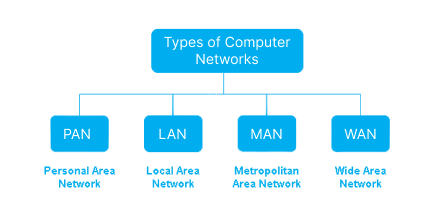
- Local Area Network (LAN)
- Wide Area Network (WAN)
- Wireless Local Area Network (WLAN)
- Metropolitan Area Network (MAN)
- Personal Area Network (PAN)
- Campus Area Network (CAN)
- Home Area Network (HAN)
A LAN is a network that connects
devices within a limited geographical area, such as
a home, office building, or campus. It allows
devices like computers, printers, and servers to
share resources and communicate with each
other.
A WAN is a network that spans a large geographical
area, typically connecting multiple LANs or
individual devices over long distances. It enables
communication between devices located in different
cities, countries, or continents, often using leased
lines or public infrastructure like the internet.
A WLAN is a type of LAN that uses wireless
communication technology, such as Wi-Fi, to connect
devices within a limited area. It eliminates the
need for physical cables and enables mobility for
devices like laptops, smartphones, and tablets.
A MAN is a network that spans a larger geographical
area than a LAN but smaller than a WAN, typically
covering a city or metropolitan area. It provides
high-speed connectivity to connect multiple LANs and
support services like broadband internet access and
digital TV broadcasting.
A PAN is a network that connects personal devices
within a short range, typically within a person's
immediate vicinity, such as a smartphone, tablet,
laptop, or wearable device. It enables communication
and data exchange between personal devices for tasks
like file sharing, device synchronization, and
wireless peripheral connectivity.
A CAN is a network that interconnects multiple LANs
within a university campus, corporate campus, or
large institution. It provides high-speed
connectivity to support communication between
departments, research facilities, and administrative
offices.
A HAN is a network that connects devices within a
residential home or apartment. It allows devices
like computers, smart TVs, home automation systems,
and IoT devices to communicate with each other and
access shared resources like internet connectivity
and multimedia content.
A VPN is a secure network connection established over a
public network, typically the internet, to enable remote
users or branch offices to access a private network
securely. It encrypts data transmitted over the network
to protect it from unauthorized access and interception.